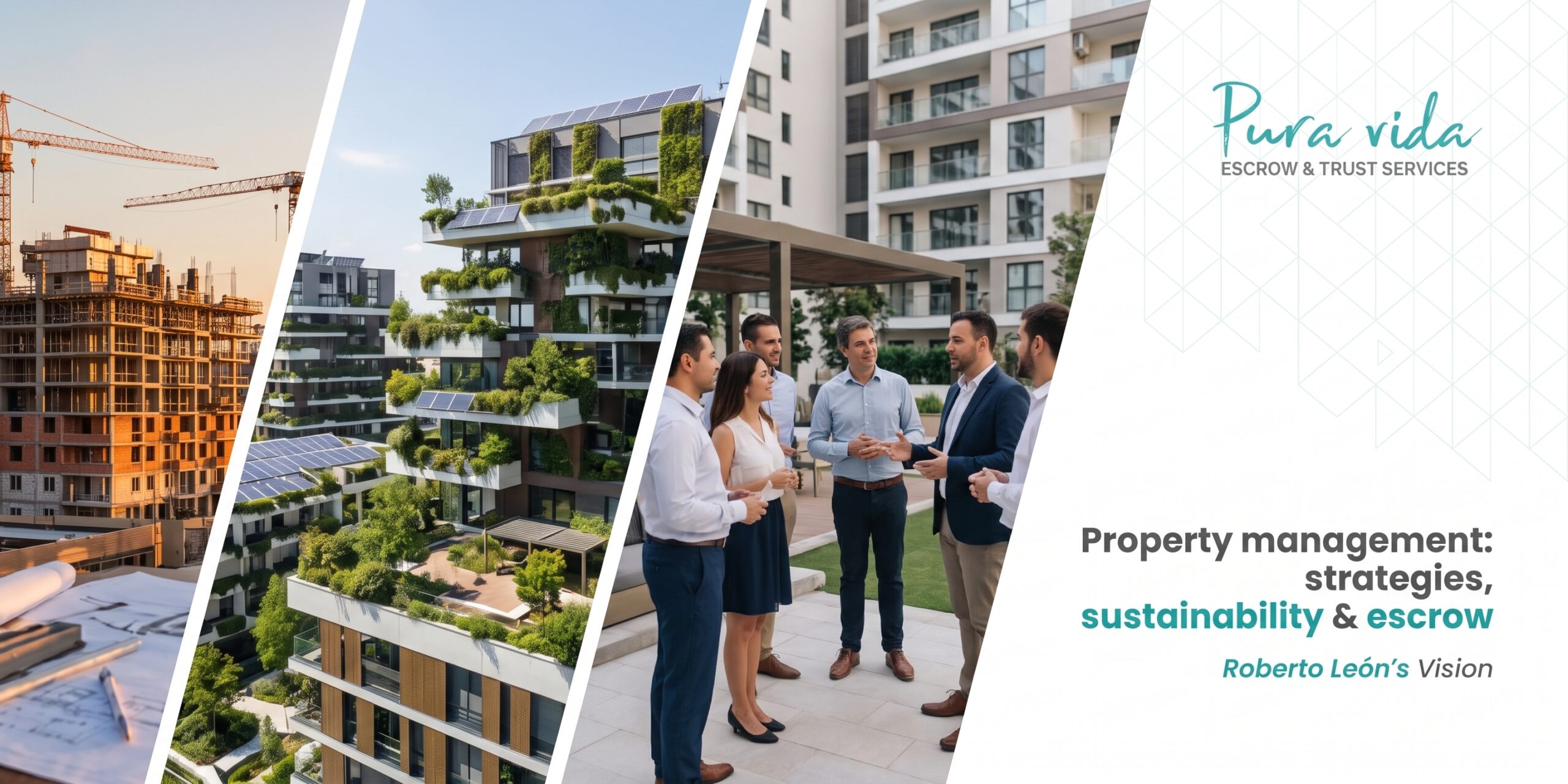
Real estate property management demands balancing legal precision, operational efficiency, and a human vision oriented toward the well-being of owners and investors. In a dynamic market like Costa Rica’s, making strategic decisions is essential to preventing friction and protecting assets over the long term. Various disciplines converge in the real estate sector, ranging from real estate project management focused on the initial stages of development, to operational structuring in mature assets. Likewise, specialized sectors such as commercial and industrial real estate demand solid methodological standards that ensure liquidity and sustainability over time.
To analyze these challenges in depth, we spoke with Roberto León Leitón, a specialist who combines legal training, experience in condominium administration, and a deep passion for hospitality.
An Interdisciplinary Approach to Dispute Resolution
The usual approach to disputes in real estate property management often lacks the breadth necessary to preserve business and neighborly relationships. A purely litigious approach increases financial costs and wears down daily coexistence among the parties involved.
When analyzing this issue, Roberto León points out:
“The main limitation I observe in this field is that conflict is approached in a one-dimensional way. As soon as a difference arises, it is transferred to the legal arena, and there, whoever has more resources to pay lawyers ends up winning. In my experience, that is almost always the worst possible outcome: all parties lose, except the lawyer.”
“Knowing the legal framework is essential because it defines the playing field. But litigation is not a solution; it is the orderly administration of a shared loss. It destroys time, capital, and, above all, the long-term relationship between neighbors, partners, or investors who will continue to coexist long after the lawsuit is resolved one way or another.”
“My legal training gives me the framework. Community management taught me to read real interests behind declared positions. And hospitality gave me something that neither of the two teaches: the discipline of anticipating annoyance before it becomes a complaint, and the complaint before it becomes a lawsuit.”
“When the parties arrive closed to a single desired solution, my method is to open the problem in all its aspects, lay out the options on the table with absolute transparency—including the real cost of litigating—and build the alternative that satisfies the majority and protects the common good. Transparency, more than an ethical principle, is a negotiation tool: when everyone sees the same playing field, positions stop being closed and become negotiable.”
Critical Errors in Long-Term Planning
Generating consistent value requires avoiding structural mistakes during the different stages of property development. A lack of financial and strategic planning often compromises the viability of promising assets.
Roberto León highlights three recurring mistakes made by developers and owners:
-
Lack of understanding of project stages and financing:
“There is a pre-feasibility stage, essentially composed of legal and engineering expenses; if its results are negative, it can also be the first and last stage, and it takes a cool head to abort a project that is not viable. Next comes the permit process, which in Costa Rica can take years. Then development: earthworks and construction. And finally operation, which does not generate income automatically and usually requires working capital to sustain itself during a period. In all those stages, the project only consumes funds. The return comes later than in almost any other asset class, and whoever does not project that lag ends up financing their own project under the worst possible conditions, or selling it at a discount right before it starts to yield.”
-
Absence of an ageless strategy:
“It is not understanding what the differentiating element of the product is and, furthermore, not knowing how to sell it. We live in very changing times, so we must conceive timeless projects that do not depend on the trendy site or the architectural style in vogue. This always reminds me of friends or relatives who ask me if they can build and manage an Airbnb or a small hotel next to their house or on an inherited property. Never believe anyone who tells you they are going to bring the people. The rule is exactly the opposite: you invest where people are already going, or where there is solid evidence that they will go in the near future.”
-
Uncertainty in the legal and financial operational scheme:
“I have come across large and well-known projects that reach the development stage without clarity on when the developer will no longer have to finance the operation of the development and when and how that weaning will occur, after which it will be the owners who finance the maintenance of the infrastructure and other common elements. Many developments are structured as a condominium of condominiums, which is a valid form but has its complexities. Frequently, there is no clarity as to how and who will finance the maintenance of the different common areas over time. When that is not resolved from the beginning, it gets resolved years later in an impossible assembly or before a judge.”
Pillars of Property Management: Sustainability, Planning, and Innovation
Modern real estate property management rests on principles that ensure the asset’s longevity and collective well-being. Sustainability, advance planning, and continuous technological adoption are no longer optional components.
Regarding these pillars, the expert emphasizes:
-
Sustainability:
“Sustainability today is a premise, not a line item in the budget. We cannot continue to be so irresponsible as to develop projects that do not generate a positive impact on the environment and the community. It is not just about cushioning the damage caused by development; it is about leaving a better place for the ecosystem and for the people who live around it. And this is no longer just an ethical principle of the developer: it is an explicit demand of today’s consumer and an elemental duty of those of us who inhabit, for now, the only available planet.”
-
Planning:
“Planning is, in essence, deciding before urgency decides for you. It is the tool that allows properties to be managed efficiently and resources to be allocated well. Without plans, we inevitably end up overspending: expense and financing plan, preventive and corrective maintenance plan, emergency plan, low season plan, high season plan, business continuity plan, etc. Improvisation is always paid for at emergency prices.”
-
Innovation:
“Innovation is a mandatory investment, not an optional one. Every day new technological solutions emerge, and that pace will grow proportionally to the advance of artificial intelligence. They not only save resources: they make people’s lives easier and more comfortable, which is one of the noblest ways to generate value in a development or community. The technology that makes a difference today will be standard in three years; and the one that is not adopted on time ends up adapting anyway, more expensive and worse implemented.”
Human Mediation and Community Leadership
Aligning diverse interests within a residential or resort complex requires sharp interpersonal skills. The mediator must separate personal tension from technical objectives to reach balanced agreements.
When explaining his negotiation strategies, Roberto León highlights:
“The mediator’s first job is not about the conflict; it is about oneself. One of the great challenges is achieving abstraction from the people and interests involved.”
“Very frequently, conflict is personalized and the opposing party’s interests are demonized. This is especially acute in a small country like Costa Rica and in an environment as polarized as the current one, where positions are easily stereotyped […]. The moment a position of this type is assumed, it becomes a personal problem, and a battle of egos.”
“That is why I address conflicts holistically and multidimensionally, considering all their dimensions and not just the legal one. That implies tapping into resources that are not usually accounted for but prove decisive: intuition, managing energies and dynamics between people, the venue, the timing, the agenda, the angle from which the discussion is framed. The exact same proposal can fail on a Tuesday in a boardroom and thrive on a Saturday walking the property.”
“In practice, I try to separate the person from the problem, translate positions into interests, deliberately design the agenda order starting with what unites rather than what divides, and ensure each party feels genuinely heard before asking them to yield. Nobody yields to someone who didn’t listen to them first.”
Legal Security and the Role of Escrow in Real Estate
Transparency in holding third-party funds has become an essential requirement for providing certainty to domestic and international investors in real estate property management.
Regarding the regulatory framework and the function of the escrow agent, Roberto León explains:
“With the new regulations on anti-money laundering, escrow ceased to be an accessory procedure and became a central piece of the transaction. Today, the escrow agent is subject to a series of operational requirements, including registration and supervision by SUGEF. Currently, the agent must accredit the origin of funds, among other duties to fulfill in every transaction, and that changed the nature of the service; it is no longer just custody, today there are also a series of responsibilities assumed by these firms.”
“Impartiality is the point that was previously overlooked. For years, it was normal for a law firm to operate its own account, so that the lawyer of one party held the funds for both. That conflict of interest was not perceived until controversy arose.”
“The other critical point is the drafting of the instrument: the destination of funds under each scenario must be defined with absolute clarity, leaving no room for interpretation. Any ambiguity ends up converted into contradictory instructions and an agent paralyzed between two parties.”
“If escrow gained that status in Costa Rica, it was not only due to regulation, but because a group of firms decided to treat the custody of third-party funds in an impartial and professional manner. That is why its use expanded beyond holding earnest money or deposit money while due diligence studies were approved in a property purchase. Now they participate in a variety of real estate transactions such as disbursements against construction progress, warranty holdbacks, co-investments, and others. That regulation and standard is what allows a foreign investor to close here today with the same peace of mind as in their home country.”
Market Evolution and Key Recommendations
Changing global demand behavior transforms traditional lodging and property management frameworks. Analyzing these dynamics helps identify solid investment opportunities.
When examining the market direction in Costa Rica, Roberto León notes:
“Major hotel chains are strongly introducing branded residences, combining the best of two worlds: full ownership and hotel service standards, backed by a brand.”
“Nor can we ignore the relative decline of Airbnb, which experienced a considerable boom, particularly during the pandemic. There will always be a market for vacation rentals, but not all are profitable on the terms claimed today.”
“In parallel, the value of hotel comfort is returning, though not in its traditional format. Guests today seek an experiential approach, and hotels that fail to offer it will compete solely on price, which is the worst kind of competition. And mixed-use developments are gaining ground, where commercial and service elements coexist with residential spaces.”
“As for advice to maximize returns, the first is strategy. And I am not referring to abstract or high-flown concepts: it is having absolute clarity about your market, your competition, and above all, about the simplest and most frequently omitted aspects: the what, the how, and the when. To that, I would add the three elements I mentioned earlier—sustainability, planning, and innovation—because in my experience, they are the tools that bring any real estate project closest to success.”
Roberto León Leitón
General Manager | Luxury Residences, Resort Communities & Hotel Operations | HOA & Vacation Rental Programs MBA Finance · Attorney | Costa Rica & LATAM
Successful real estate property management requires integrating technical rigor, clear legal design, and communication geared toward mutual understanding. Incorporating tools such as escrow accounts and maintaining rigorous operational plans protects investments and enhances community convenience.
We sincerely thank Mr. Roberto León Leitón for sharing his valuable professional experience and timely insights with our audience.