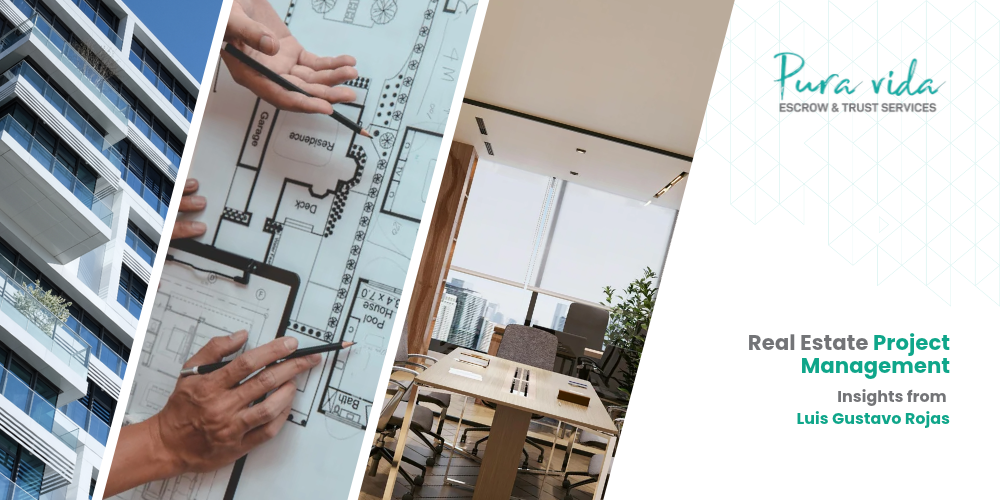
Real estate project management is undergoing a profound technical and operational transformation in Costa Rica. Changes in work habits and market dynamics require developments to precisely balance cost, time, and quality.
To understand current industry dynamics, it is key to examine commercial real estate investment in Costa Rica. Similarly, trends in residential and corporate segments closely align with luxury real estate in Costa Rica and the evolving demands of buyers and investors.
On this occasion, we spoke with Luis Gustavo Rojas, specialist at Portafolio Inmobiliario, who shares an analysis of market evolution, risk mitigation, and emerging technologies.
Space Transformation and New Market Demands
The construction and space design landscape has experienced a radical shift following the pandemic. Operational adaptability has become a primary requirement for tenants and companies seeking to optimize their facilities.
Luis Gustavo Rojas highlights that the perception of workspace permanently changed after the global health crisis:
“Based on my experience managing internal fit-out projects for our tenants, I have realized that there is a before and after Covid. People learned to use video calls, learned that working from home is possible, and learned to have operational flexibility. That is reflected in today’s real estate requirements: so much square footage is no longer needed, and designs are no longer as rigid with massive workstations, but rather collaborative and flexible spaces that allow for co-living and emotional stability similar to home or a relaxation area.”
This shift toward collaborative environments requires adjusting traditional planning and interior design parameters.
The Challenge of Balance: Time, Cost, and Quality
Leading large-scale developments involves managing complex expectations among multiple stakeholders. Success in real estate project management depends on harmonizing fundamental technical management variables without compromising the final result.
Regarding this constant alignment challenge, Rojas emphasizes:
“The most complicated part is fulfilling client expectations in alignment with the three standards of project management: time, quality, and cost. Very frequently, there is a cost expectation that is not congruent with time and quality, and vice versa among them. The core of our work is to deliver a satisfying product across those three lines, where sometimes we must explain to the client that they need to balance their priorities on a scale.”
Risk Mitigation and Neutral Technical Supervision
The complexity of modern developments requires solid contractual frameworks that protect invested capital and ensure compliance with agreements. Assessing risks impartially is an indispensable requirement for the financial stability of all parties involved.
In the specialist’s words, having impartial auditors and neutral third parties guarantees transparency throughout the construction lifecycle:
“Indeed, risks are a crucial part of project management. Our contracts across all projects include a risk matrix right from project negotiation. These contracts are drafted by a third party to protect the interests of both clients and the technical team involved. Having this technical figure with external eyes is crucial to assess risks for both parties without tipping the balance toward either.”
Transparency and Key Drivers in Real Estate Project Management
Building mutual trust among developers, tenants, and investors requires establishing open communication channels and clear management methodologies. Operational transparency strengthens long-term corporate relationships.
Luis Gustavo Rojas underlines how creating strategic value depends on this relationship of trust:
“The main strategy I rely on for transparency and trust is long-term relationships. A well-executed project can open many doors to continue growing as a professional and as a firm dedicated to project management, which generates added value in the market. It is all a value chain that creates client satisfaction—understanding that the client can trust the multidisciplinary team executing the project during design and construction adds real value to the firm. It is normal for clients to mistrust costs or technical advice they are unfamiliar with, but when that bond of trust is built starting from the project manager, great successes can be achieved.”
Furthermore, in pre-sale or corporate financing schemes, fund management demands rigorous accounting controls. When addressing the implementation of transparent fund management systems, Rojas explains:
“Super important—part of our core business is that we work with an Open Book system. The client always has access to any quote and cost-level decision made. This means always having financial statements of incoming or outgoing funds readily available, with total clarity and no doubts or grey areas.”
Emerging Trends and Technological Innovation
Technology applied to construction and operations management is redefining efficiency standards. Integrating digital tools optimizes processes from the conceptual phase through post-construction maintenance.
Regarding the impact of these innovations on real estate project management, the expert concludes:
“Artificial intelligence is definitely becoming an ally in all project management. Today, an architectural test fit can be generated using a smart engine in just two hours. Remote inspections can be conducted with digital access and cameras, allowing multinational corporate clients to review progress from their home country and determine whether the schedule is being met or delayed. The BIM methodology exported to an operational level—where corrective and preventive maintenance is automated after construction ends—will be the new normal in a few years.”

Luis Gustavo Rojas Moraga
Project Management
The real estate sector is evolving toward more flexible, transparent, and tech-driven models. Maintaining operational strength requires properly balancing cost, time, and quality metrics, supported by clear and impartial contractual structures.
We sincerely thank Luis Gustavo Rojas for sharing his experience and specialized analysis on real estate project management in Costa Rica. His insights offer valuable guidance for industry professionals and investors.